
Finney County Court Records After Arrest
A jail arrest and a court case are related, but they are not the same record. The jail roster can show the booking charge, arresting agency, bond field, and booking date. The court record begins when the Finney County Attorney reviews reports and files formal charges in district court. Sheriff Steven R. Martinez's office is one of the agencies that can submit cases, and the County Attorney's Office prosecutes felony crimes, drug crimes, domestic batteries, misdemeanors, juvenile crimes, and traffic cases from agencies including the sheriff, Garden City Police, Holcomb Police, Kansas Highway Patrol, KBI, DEA, ATF, INS, and DCF.
The court record is where the filed charge, case number, judge, hearing dates, attorney names, and later charge status appear. For the custody side, use Finney County jail inmate records. For booking photos, use the Finney County jail mugshots page. Court records after a jail arrest should be read as prosecution records, not as a promise that a person was convicted.
Find Court Records After Arrest
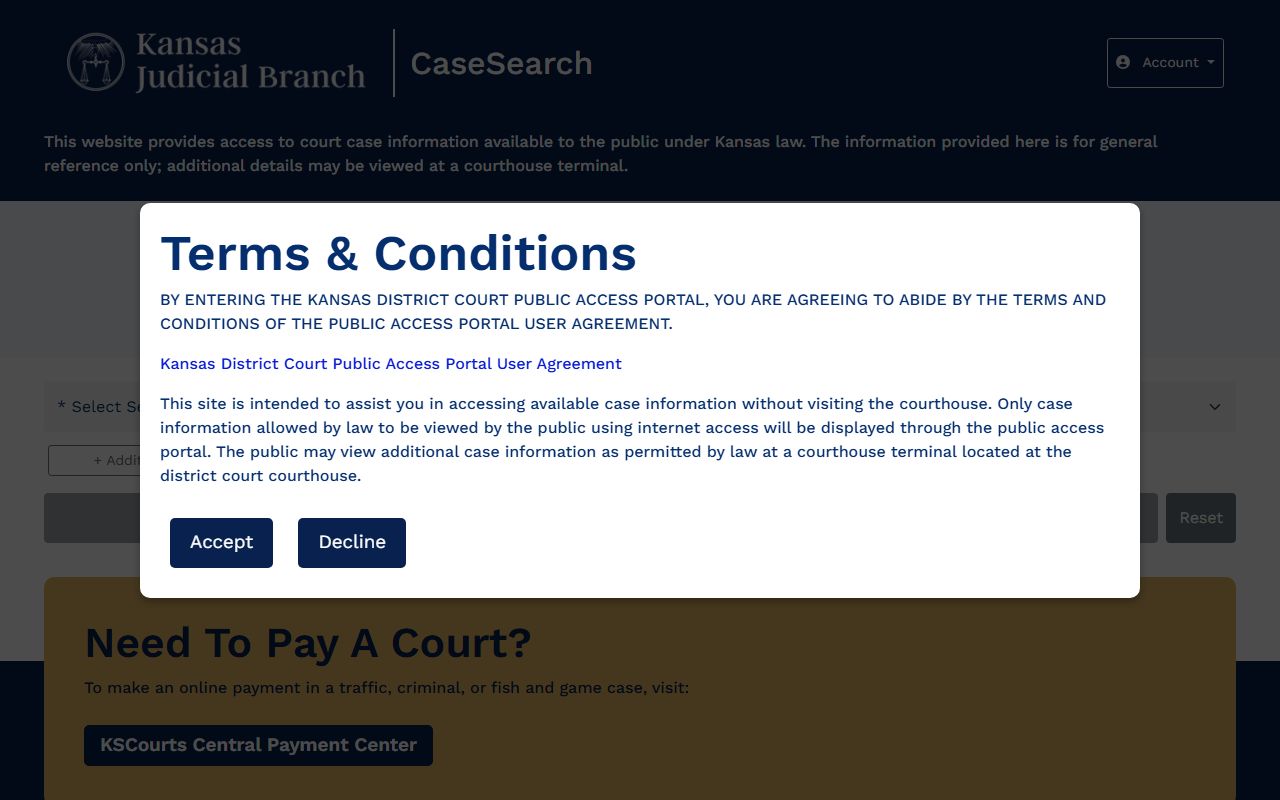
The main statewide portal is Kansas Case Search. The Kansas Judicial Branch says district court records may be searched by case number, party name, business name, citation, or other criteria available by role. Case information can include the case number, case type, people involved, attorney names, assigned judge, and hearing dates. If a case is not available online, the Finney County District Court clerk or a public courthouse terminal may be needed.
- Start with the jail roster to capture the booking date, arresting agency, visible charge, and booking number.
- Allow time for prosecutor review and court filing, because booking charges can differ from filed charges.
- Search Kansas Case Search by defendant name, case number, or citation when known.
- Open the Finney County case result and read the charge list, hearing dates, and current case status.
- Contact the court clerk when the online search does not show a recent filing or a sealed record limits access.
The Kansas Case Search source page is the official statewide court search starting point.
Finney County Case Search Fields
The court search fields are broader than the jail roster fields. A name search is useful when no case number is known, but common names require confirmation against county, case type, dates, and charge information. A citation or case number is stronger when it comes from court papers, a ticket, counsel, or the clerk.
| Field Label | Type | Required | Notes |
|---|---|---|---|
| Case Number | Text | Optional | Best when known from court paperwork, clerk information, or counsel. |
| Party Name | Text | Optional | Search defendant name and confirm identity before relying on a result. |
| Business Name | Text | Optional | More relevant for non-criminal or business-party matters. |
| Citation | Text | Optional | Useful for traffic or citation-driven cases. |
| Other role criteria | Variable | Role-dependent | The portal says extra options may depend on the user's role. |
Charges Filed After Arrest
After a Finney County arrest, the prosecutor decides what charge, if any, should be filed. The jail entry may reflect a booking allegation, a warrant, a detainer, or a preliminary charge. The court record reflects the document filed to start or continue the prosecution. Kansas district court criminal cases commonly involve complaints or informations, and indictments are possible in grand-jury cases.
| Document | Who Files It | How It Functions |
|---|---|---|
| Complaint | Prosecutor or authorized complainant | States the alleged offense and can start a criminal case. |
| Information | Prosecutor | Formal charging document often used after review or preliminary proceedings. |
| Indictment | Grand jury | Formal accusation returned by a grand jury in qualifying cases. |
Charge Status Meanings
Charge status can change after the arrest. A pending charge is not a conviction. A filed count may be amended, reduced, dismissed, or resolved by plea, trial, diversion, or another court order. That is why jail booking text should be compared with the case docket rather than treated as the final legal outcome.
| Status | What It Means |
|---|---|
| Pending | The charge remains unresolved in court. |
| Amended | The prosecutor changed the charge or wording. |
| Reduced | The charge was lowered to a lesser offense or level. |
| Dismissed | The court or prosecutor ended that count. |
| Conviction | Guilt was entered or found by plea, verdict, or other qualifying judgment. |
Bond After Finney County Arrest
Bond is court-driven. A warrant, schedule, judge, or first appearance may control the amount and release conditions. The Finney County roster has a visible Bond field, but it does not explain the bond type. A zero or blank field may reflect a no-bond hold, detainer, missing release amount, or another agency action. Jail staff can give custody and bond-status information, but the sheriff's FAQ says staff cannot recommend a bail bondsman.
| Bond Type | How It Works |
|---|---|
| Cash bond | Money is posted as ordered by the court or accepted office. |
| Surety bond | A licensed bond agent posts bond; the family chooses the company. |
| Personal recognizance | Release is based on a promise and court conditions rather than full cash posting. |
| No-bond hold | Release is not available until the court or holding agency acts. |
Important: The sheriff's 2025 scam alert warned that the office does not call asking for bail money; verify bond directly.
Finney County Warrant Records
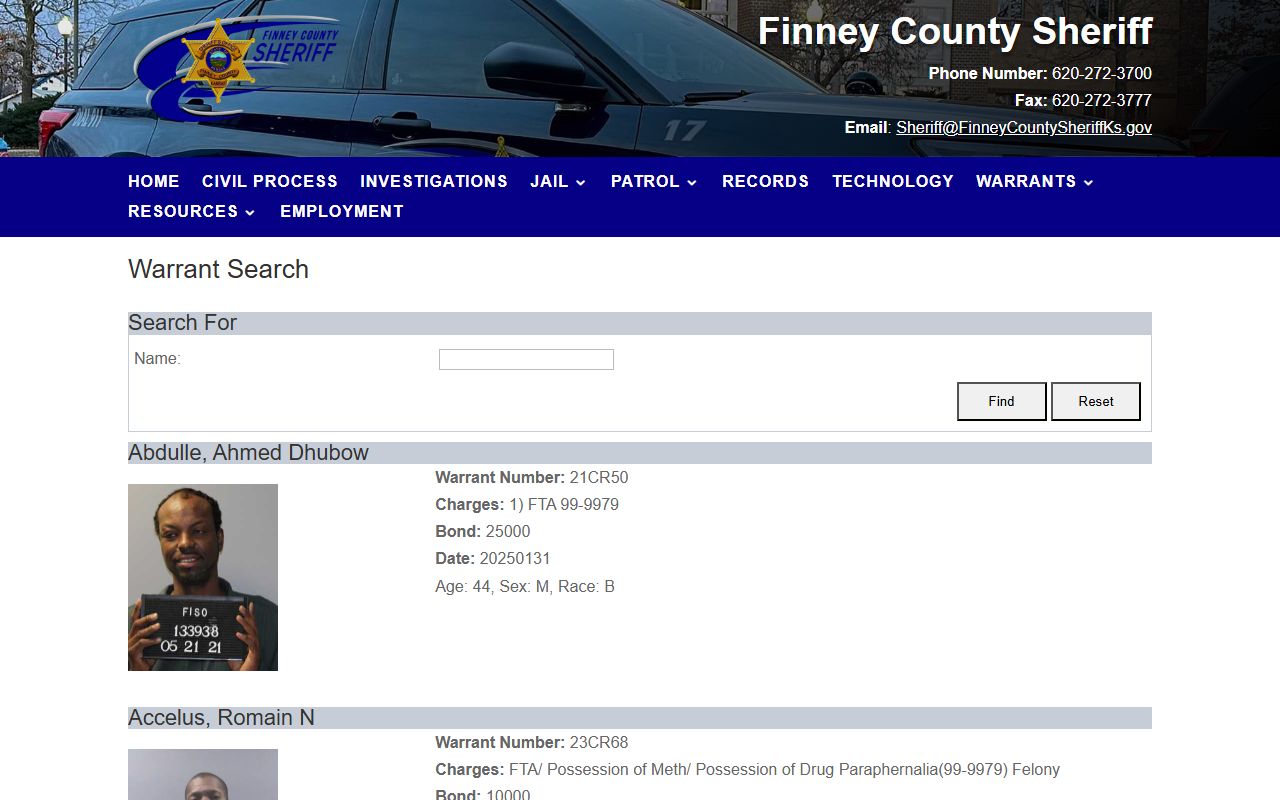
The sheriff's public warrant search is separate from the custody roster. It lists active warrants by name and can show a warrant number, charges, bond, date, age, sex, race, image, and pagination. A warrant can lead to a jail arrest, then later to jail roster and court records. Bench warrants and case-linked warrants may also need a District Court or Kansas Case Search check.
The warrant list source page documents the public name-search channel.
Charges vs Convictions
An arrest means a person was taken into custody. A charge means the state has made an accusation in court. A conviction means guilt was entered or found through the court process. Court records after a jail arrest may show all three stages at different times, and public users should avoid treating a booking or charge as proof of guilt.
| Charge | Conviction | |
|---|---|---|
| Stage | Accusation after arrest or filing | Final or qualifying finding of guilt |
| Record source | Complaint, information, indictment, or docket | Judgment, plea, verdict, or sentencing entry |
| Can change? | Yes, it can be amended, reduced, or dismissed | May be appealed, corrected, or expunged if eligible |
Sealed and Expunged Records
Kansas public access has limits. Sealed records are withheld from ordinary public view by law or court order. Expungement is a court process that can limit public access to qualifying convictions, arrest records, and diversions after statutory conditions and waiting periods. K.S.A. 21-6614 sets the Kansas expungement procedure.
| Sealed | Expunged | |
|---|---|---|
| Public view | Hidden from general public access | Public access is restricted after court order |
| How it happens | Law or court order | Petition and court process under Kansas law |
| Scope | May apply to a case, document, or category | Applies to qualifying convictions, arrests, or diversions |
KBI Criminal History Checks
The Kansas criminal history record search is a separate KBI central repository search. Research found a $30 public name-based purchase price and a daily maintenance window. KBI instructions say public checks do not release every nonconviction, diversion, expunged, stale undisposed, or juvenile record to the general public. That makes a KBI check different from checking a Finney County jail booking, a court docket, or a warrant list.
Important: Public court and jail lookups are not FCRA consumer reports and should not be used for regulated screening decisions.
Finney County Court Contact
Finney County District Court is part of the 25th Judicial District. The district court page lists Clerk Christine Blake and gives phone options for Spanish, jury information, traffic and criminal matters, marriage license, domestic, child support, collections, small claims, civil lawsuits, and juvenile or minor matters. The court page also links users to the search-records channel.
Finney County District Court
425 N. 8th Street
Garden City, KS 67846
620-271-6120
Monday-Friday 8 a.m.-5 p.m. Central
Finney County Attorney
409 N. 9th Street
Garden City, KS 67846
620-272-3568
Monday-Friday 8 a.m.-noon and 1 p.m.-5 p.m.